

Key takeaways
- Cool-season grasses such as tall fescue and Kentucky bluegrass grow hardest in spring and fall, so most of your effort belongs in those windows.
- Mow tall, remove no more than a third of the blade at once, and raise the mower in summer heat.
- Clay soil holds nutrients but compacts easily. A soil test and yearly core aeration do more than extra fertilizer.
- Early fall is the best time to feed, aerate and overseed. Skip heavy nitrogen in midsummer.
- Water deeply and less often, early in the morning, rather than a little every day.
Cool-season grasses that suit Southwest Ohio
Southwest Ohio sits firmly in cool-season grass country. Summers are hot and humid and winters are cold, so the grasses that last here grow fastest in spring and fall and slow down in July and August. These are the ones you will run into most:
- Tall fescue. Deep roots, good heat and drought tolerance, and the most forgiving choice for sun and part shade. It grows in clumps, so thin spots need seed rather than waiting for the grass to fill in.
- Kentucky bluegrass. Dense, dark green and able to repair itself through underground stems. It is slow to establish and thirstier in a dry summer, and it may turn tan and dormant before recovering when the rain returns.
- Perennial ryegrass. It germinates quickly, which is why it appears in most seed blends. On its own it handles hard winters and summer heat less well.
- Fine fescues. The best of the group in shade and thin soil, so they suit lots under mature trees.
Most lawns here are a mix of these, and that is fine. Warm-season grasses such as zoysia and bermudagrass can survive in the region, but they stay tan from the first hard frost until late spring, and most homeowners find that a poor trade. Before you change anything, find out what you have and how much sun each part of the yard actually gets.
Clay soil and what it means for your lawn
Much of Southwest Ohio has clay-heavy soil. Clay holds nutrients well, but it drains slowly, stays soggy in spring, and bakes hard in a dry summer. Grass roots struggle to go deep in it, which is why lawns on clay can look fine in May and thin out by August.
Compaction makes this worse. On newer subdivision lots, the topsoil was often scraped off and the ground driven over during construction, leaving a thin layer of soil over hard subsoil. Older neighborhoods usually have more organic matter, but foot traffic, mowers and years of runoff still pack the surface down.
What helps:
- Test the soil. Your county's OSU Extension office or a soil lab can tell you your pH and nutrient levels. Add lime or phosphorus only if the test calls for it.
- Core aerate every year or two. It is the most effective single step on clay.
- Topdress with a thin layer of compost after aerating, to build organic matter over time.
- Do not mix sand into clay. It can make a layer that is harder than what you started with.
Standing water after rain, soft spots that never dry, and water running toward the house are grading and drainage problems. Fertilizer will not fix them, and regrading or installing drains is a job for a pro.
Mowing height and habits
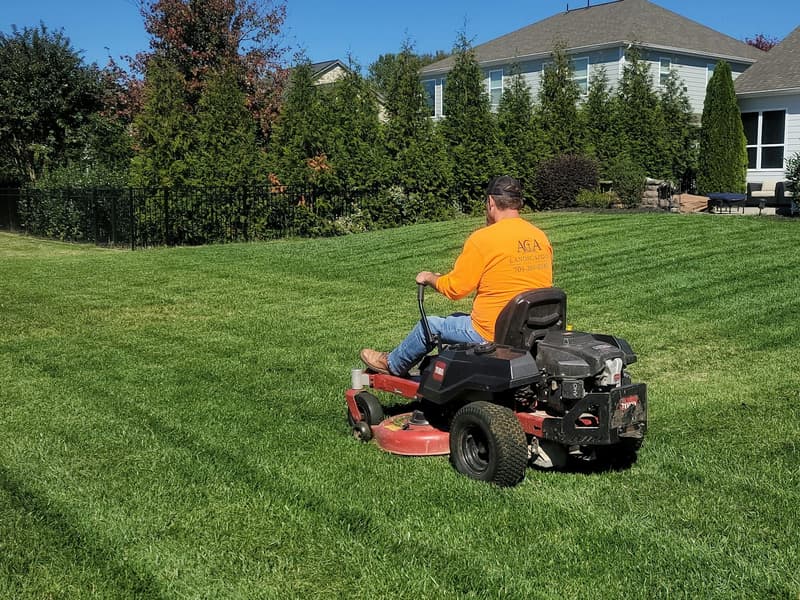
Mowing is the thing most people get slightly wrong. For cool-season lawns, mow tall: roughly 3 to 4 inches for tall fescue, and about 2.5 to 3.5 inches for Kentucky bluegrass and most mixes. Taller grass shades the soil, keeps roots deeper, and crowds out weed seeds that need light to sprout.
Follow the one-third rule. Never remove more than a third of the blade in a single mowing. In the fast growth of May and early June, that can mean mowing every five days or so instead of every week.
Keep the blade sharp, since a dull one tears grass and leaves a gray, ragged tip. Leave the clippings on the lawn when they are short and dry, because they return nitrogen to the soil. Raise the deck in summer heat, and take the last few cuts of the year slightly shorter, around 2.5 inches, so the grass does not mat under fallen leaves.
The details, including what to do in a heat wave, are in How to mow your lawn at the right height.
A fertilizing calendar for the year
Cool-season grass wants most of its food in the fall, a little in spring, and very little in summer. A calendar that fits the region:
- Late March to April. Apply a crabgrass preventer when soil temperatures have reached the mid-50s Fahrenheit for several days, usually around the time forsythia is blooming. It has to go down before crabgrass germinates. Do not use it where you plan to seed.
- May. A light feeding is optional. Heavy spring nitrogen pushes top growth at the expense of roots just before summer stress.
- June through August. Skip heavy nitrogen. If you want to feed, use a slow-release product at a light rate, and never on drought-stressed grass. Late summer is also when beetle grubs feed near the surface, so watch for patches that lift like carpet.
- September. This is the main feeding of the year, alongside aeration and overseeding. The soil is warm and the grass is growing hard.
- Late October to November. A final feeding while the grass is still green but slowing down helps it green up early next spring.
Broadleaf weeds such as dandelion and clover are best treated in fall, when they are moving energy down into their roots.
Read the label on every product and follow the rate exactly. Keep spreaders off driveways and sidewalks, sweep stray granules back onto the grass, and do not apply before heavy rain or on frozen ground, since the product washes into storm drains. If you are treating near a well, pond or stream, or around trees, have a professional do it.
Aeration and overseeding in fall
Late August through September is the best window in Southwest Ohio for fixing a lawn. Soil is still warm, nights are cooler, there is less weed competition, and rain is more reliable than in summer. Seed sown in spring has to survive the heat of July with young roots.
Core aeration pulls small plugs of soil out of the lawn, which opens up compacted clay so air, water and seed can reach the roots. Overseeding right after aeration puts seed into those holes, where it stays moist and in contact with soil. Choose seed that matches your light and your existing grass, and keep it damp until it has sprouted.
The full steps, including seed choice and watering, are in Fall aeration and overseeding.
Watering a cool-season lawn
Established lawns need about an inch of water a week during the growing season, counting rain. Water deeply and less often, rather than a little every day. Deep watering pushes roots down, while daily sprinkling keeps them shallow and fungus-prone.
Water early in the morning, when it is calm and cool, so the blades dry during the day. Evening watering leaves grass wet overnight and invites disease in our humid summers. A few empty cans or tuna tins set out on the lawn will show you how long your sprinkler takes to deliver an inch.
Clay soil takes water slowly, so if you see puddling or runoff before the inch is down, water in two shorter sessions an hour apart. In a long dry spell, bluegrass may go tan and dormant. It usually recovers in fall, and a half inch of water every couple of weeks keeps the crowns alive.
New seed is the exception. It needs light, frequent watering until it germinates, as described in the fall guide.
When to bring in a landscaper
Much of lawn care is work you can do yourself on a weekend. Call a professional for grading and drainage problems, for any slope too steep to mow safely, for large areas of grub damage, for treatments near wells, ponds or trees, and when a rented aerator is too heavy to handle comfortably. If you are unsure which of these you are dealing with, see lawn care services or get in touch and ask a local landscaper to look at the yard.
Frequently asked questions
What is the best grass for Southwest Ohio?
For most yards, a tall fescue or a blend with Kentucky bluegrass does well in sun and part shade. Fine fescues are better under heavy tree cover. The right choice depends on how much sun you get and how much foot traffic the lawn takes.
When should I fertilize my lawn in Southwest Ohio?
The most important feeding is in September, with a second in late fall. A light spring feeding is optional, and heavy nitrogen in midsummer is best skipped. A soil test tells you whether you also need lime or phosphorus.
Why does my lawn look thin and patchy in August?
Heat, drought, compacted clay and grubs are the usual causes. Check the mowing height first, then look for grubs by pulling up a section of dead turf. Aeration and overseeding in September is the usual fix.
Is it better to bag or leave grass clippings?
Leave them when they are short and dry, since they break down quickly and return nutrients. Bag or rake them if the grass was very tall or wet when you mowed, because heavy clumps can smother the turf underneath.
6 min read.